Armistice and Paul's Death
The final chapter of All Quiet on the Western Front records the death of Paul Bäumer, the last of the seven classmates who volunteered together. He falls in October 1918, on a day so still that the army report confines itself to the single sentence: "All quiet on the Western Front." The novel's closing image shows him lying forward on the earth as though sleeping, his face bearing an expression of calm, "as though almost glad the end had come." This death is not a dramatic battlefield climax but a quiet, almost incidental extinguishing—the logical terminus of a process the book's epigraph had already announced: the destruction of a generation of men who, even if they escaped the shells, were destroyed by the war.
The Last Survivor
By autumn 1918, Paul is the only one left from the twenty who once made up his class. Müller is dead, shot point-blank in the stomach with a Verey light; he lived for half an hour in terrible pain, bequeathing his boots—the same pair he had inherited from Franz Kemmerich—to Paul. Stanislaus Katczinsky, Paul's closest friend, died from a tiny stray splinter to the head while Paul was carrying him to the dressing station. Albert Kropp lost a leg and was sent to an institute for artificial limbs. Haie Westhus, Detering, Leer, Bertinck—all are gone. Paul himself has fourteen days' rest after swallowing a bit of gas, and he sits the whole day in a little garden in the sun. Everyone talks of peace and armistice; hope is high, and Paul believes it too. But his thoughts stop at the prospect of going home and will not go further. He feels only "greed of life, love of home, yearning for the blood, intoxication of deliverance"—but no aims.
The Quiet Day
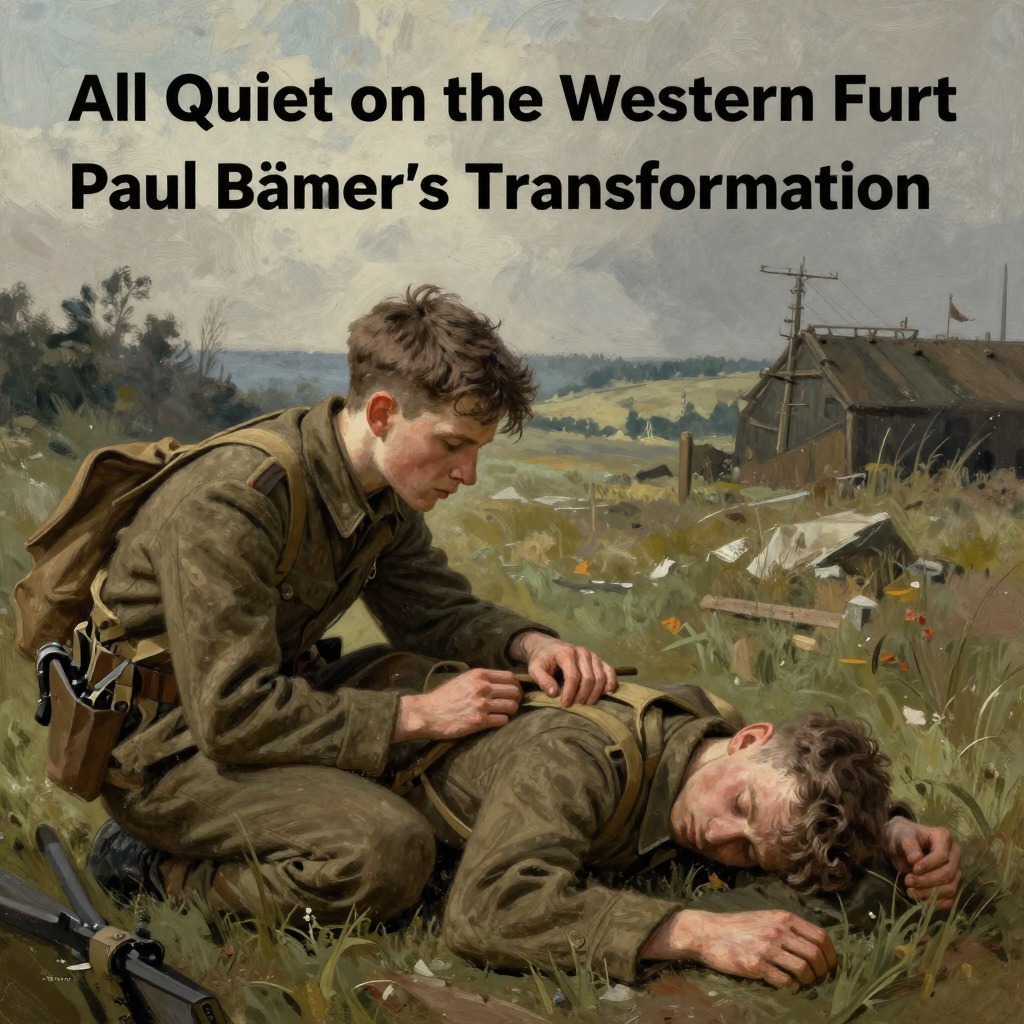
The date is October 1918. The front is so quiet that the army report contains nothing but the single sentence that gives the novel its title. Paul has fallen forward and lies on the earth as though sleeping. When he is turned over, it is clear he could not have suffered long. His face has an expression of calm, "as though almost glad the end had come." The narrative offers no account of the bullet or shell that killed him; the event is presented entirely through its aftermath, as a fact already accomplished, observed from outside. This narrative restraint—the refusal to dramatize the moment of death—mirrors the novel's larger argument: that death at the front is not an adventure but a statistical certainty, and that Paul's individual end matters less as a personal tragedy than as the completion of a collective fate.
The Generation That Will Not Be Understood
Paul's death is preceded by a long interior meditation that constitutes the novel's final reckoning. He reflects that if he and his comrades had returned home in 1916, they might have "unleashed a storm" from their suffering and strength. But now they will go back "weary, broken, burnt out, rootless, and without hope." The generation that grew up before the war already had homes and callings and will return to its old occupations, forgetting the war. The generation that has grown up after will be strange to them and push them aside. Paul foresees that he and his kind will be "superfluous even to ourselves," that most will be bewildered, and that in the end they will "fall into ruin." He stands up, very quiet, and concludes that the months and years to come can take nothing from him because they can take nothing more: "I am so alone, and so without hope that I can confront them without fear." This is the voice of a man who has already been destroyed while still alive—the very condition the book's epigraph had promised to describe.
Narrative Frame and Significance
The death is narrated in the third person, from an impersonal perspective that shifts abruptly from Paul's first-person voice. The final paragraphs step outside Paul's consciousness to report his death as an external fact, then describe his body as it is found. This shift in narrative frame—from the intimate "I" that has carried the entire novel to a detached observer who turns the body over—enacts the final separation between the living Paul and the reader who has accompanied him. The army report's single sentence, "All quiet on the Western Front," becomes bitterly ironic: the quiet that the report records is the quiet of a generation's annihilation. The novel ends not with a cry or a protest but with a silence that the book's own existence breaks, ensuring that Paul's death—and the deaths of all the Kemmerichs, Müllers, and Katczinskys—will not be forgotten.